Your phone rings at 7:12 pm on a Saturday. Your host is walking a party of six to their table. Your server is already three deep in orders. Nobody picks up.
We've talked to plenty of restaurant operators who know this exact moment. It's not a staffing failure. It's just simple math. You can't answer the phone and run the floor at the same time.
Unfortunately, every unanswered call is business walking away.
Hostie is one of a growing number of AI tools built to close that gap.
Deloitte's 2025 State of AI in Restaurants survey found that eight in ten restaurant executives expect their AI spending to grow this year, with guest-facing tools like chatbots and voice assistants leading adoption.
Hostie is a little different. It’s a Virtual Concierge made specifically for restaurant people, by restaurant people. It’s not a general-purpose bot repurposed for hospitality.
But being restaurant-specific is only half the story. The real question is whether that focus fits how your restaurant actually operates, and whether Hostie's strengths line up with the calls you're actually missing. Here’s everything you need to know.
What Is Hostie?
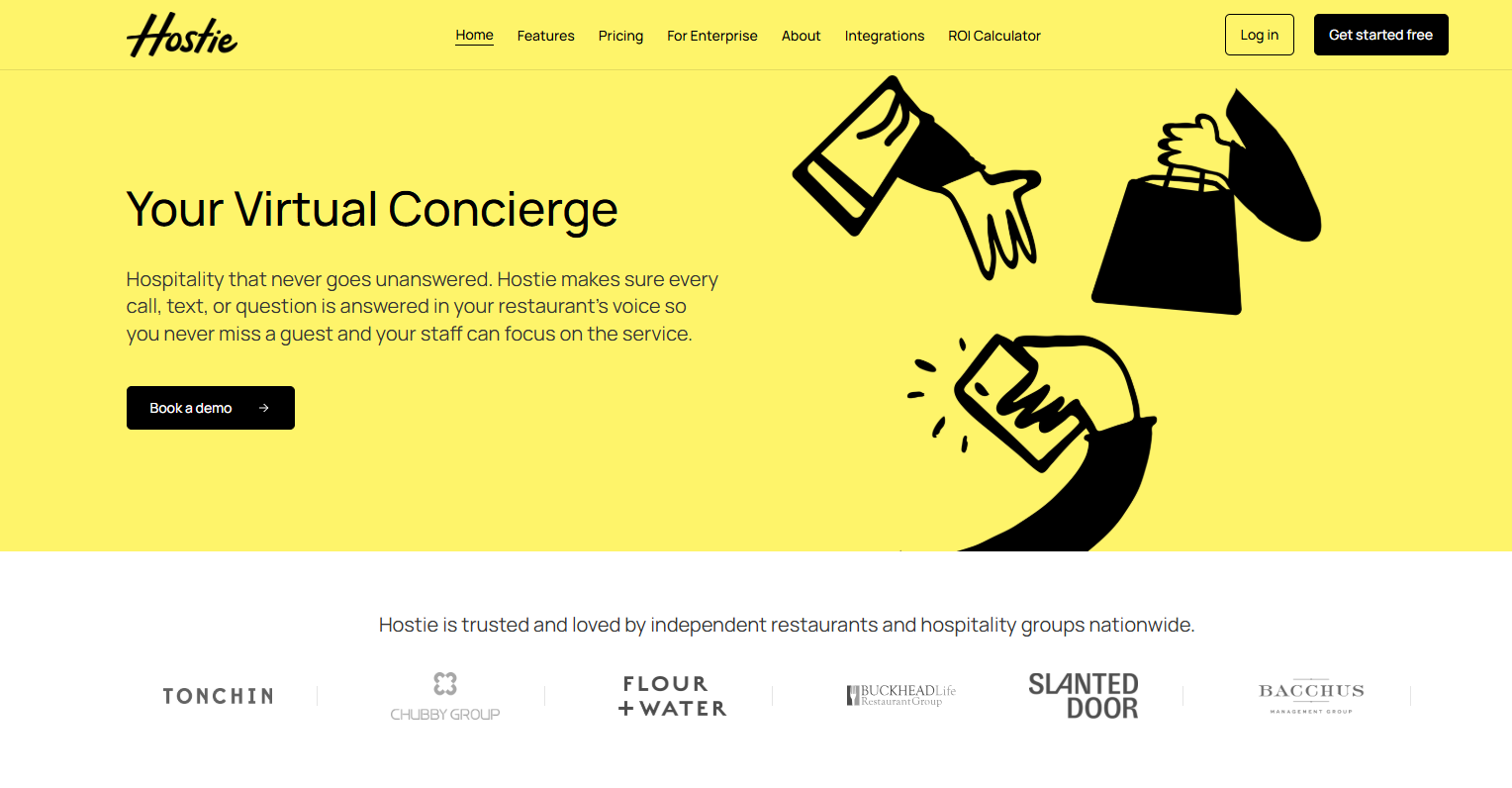
Hostie is an AI phone, text, and email answering system made exclusively for restaurants and hospitality groups. It answers guest calls in your restaurant's voice, books and manages reservations, captures takeout orders, and routes anything complicated to a staff member.
Hostie was founded by Randall Hom, a former product designer who owns the San Francisco pizzeria and natural wine bar Back to Back, and Brendan Wood, an AI engineer. Hom kept seeing his staff get pulled away from customers during service to answer the incessantly ringing phone and respond to the same questions over and over again. So he partnered with Wood and built a tool to solve it.
It has grown from five pilot restaurants in 2024 to over 200 locations today, working with names like Flour + Water and Slanted Door.
How Hostie Works
Hostie plugs into your restaurant's existing phone lines through call forwarding, so there's no need to switch numbers or hardware. Here's the actual flow once it's live.
A guest calls, and Hostie answers with a greeting built around your restaurant's tone, whether that's casual or formal.
From there, it identifies what the guest asks for through natural conversation: a reservation, a menu question, an event inquiry, or a request to speak with someone specific. For reservations, Hostie checks live availability, books the table, and sends a text confirmation.
If a request goes beyond what the AI can handle, it hands the call to staff along with a quick summary of what's already been discussed, so nobody has to repeat themselves.
This kind of automation reflects a broader shift in restaurant technology, where routine guest touchpoints get handled by software so staff can focus on the dining room.

Key Features
Hostie's feature set is built around the calls, texts, and messages a restaurant actually gets, rather than a generic customer service checklist.
- Real-time reservation booking and changes. Hostie connects directly to OpenTable, Resy, Tock, SevenRooms, and Yelp Reservations to check availability and update bookings during the call itself, not after.
- Waitlist management. When you're fully booked, Hostie can add callers to the waitlist and notify them automatically once a table frees up.
- A staff-editable knowledge base. Menu items, allergen details, hours, parking, and policies live in a dashboard your team can update without any technical help.
- SMS confirmations and reminders. Guests get a text after booking, and a reminder before their reservation, which helps cut down on no-shows.
- Private event and large party inquiries. Hostie captures event details like date, headcount, and budget, similar to what you'd gather with a solid event inquiry form, then routes the lead to your events team. Hostie integrates directly with Perfect Venue for event management, so captured event inquiries automatically create new leads there.
- Call transfer with context. Complaints, VIP requests, and detailed event planning still get handed off to a person, along with a summary so the conversation doesn't restart from scratch.
- Order capture for pickup, delivery, and catering. Through its Olo integration, Hostie can take phone and text orders for pickup, delivery, or catering, then send them straight into the POS.
What Hostie Does Well
Here are some of Hostie's biggest strengths:
Peak-hour Coverage
This is where Hostie earns its keep. Restaurant staffing hasn't fully caught up to pre-pandemic levels in every market, and the National Restaurant Association has tracked a labor force that's still tight in many regions.
When your host is seating guests and your manager is on the floor, a missed call is a missed reservation. Hostie answers instantly, no matter how busy service gets, which matters for restaurants managing restaurant staffing gaps on a nightly basis.

After-hours Booking
A lot of reservation decisions happen outside your open hours, like someone planning Saturday's dinner on a Tuesday morning. Hostie answers calls 24/7 and converts those calls into confirmed bookings instead of voicemails that may or may not get a callback.
Consistency
Front-of-house turnover is part of the industry. Food and beverage serving roles have some of the highest turnover of any occupation group, according to the U.S. Bureau of Labor Statistics.
A new host fresh out of host training might not know the tasting menu needs 48 hours' notice, but Hostie gives the same accurate answer every single time, regardless of who's scheduled that night.
Multilingual Support
Hostie’s voice AI covers more than 20 languages. That means a caller doesn't have to speak English to get a straight answer, book a table, or place an order. For restaurants in tourist-heavy or multilingual markets, that removes a real barrier and helps you serve more guests instead of losing them to a language gap.
Where Hostie Falls Short
No platform does everything, and here’s where Hostie has limitations:
Restaurant-only, By Design
Hostie is built exclusively for restaurants and hospitality groups. If your group also runs a catering company, a cooking school, or an event venue outside a restaurant setting, you'd need a separate tool for those operations.
Order Capture is Lighter Than a Dedicated Ordering Platform
Hostie can take pickup, delivery, and catering orders by phone or text through its Olo integration, but its order handling is built around guest communication and reservations first, not around payment processing and upselling the way order-first platforms are.
If phone-order revenue is your top priority, it's worth weighing Hostie against tools built specifically around that workflow.
Complex Situations Still Need a Human
Detailed conversations, VIP handling, and drawn-out event negotiations get routed to staff. That's standard across this category of tool, but it's worth setting expectations that Hostie complements your team for these moments rather than replacing them.
Hostie Pricing
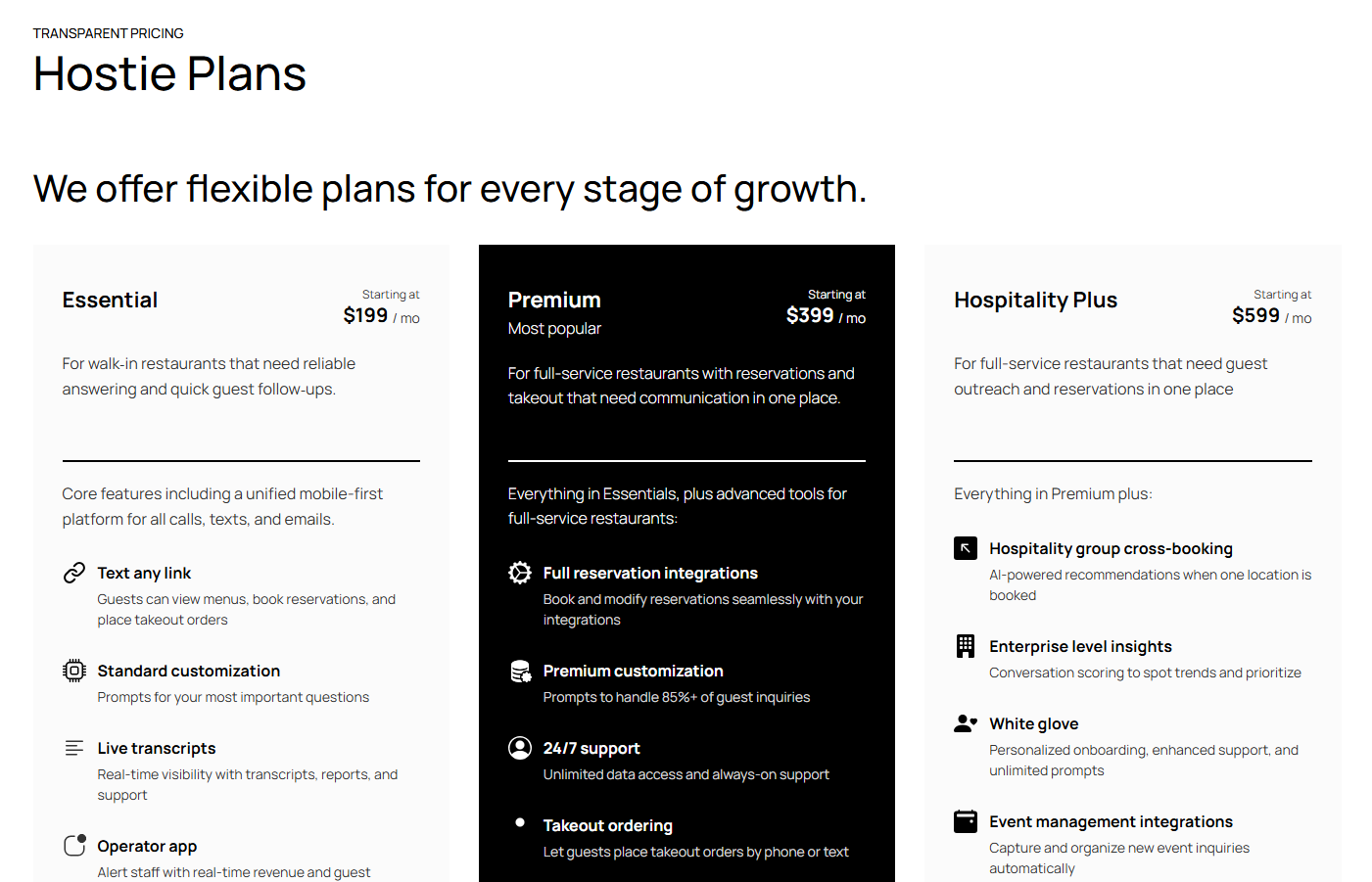
Hostie has three plans.
- Essential starts at $199 per month and covers unified call, text, and email handling with standard customization.
- Premium starts at $399 per month and adds full reservation integrations and 24/7 support.
- Hospitality Plus starts at $599 per month and adds cross-location booking and white-glove onboarding for multi-unit groups.
Who Hostie Is Best For
Whether Hostie is worth adding really depends on your call volume, your reservation setup, and how much of your business is order-driven versus reservation-driven.
Good Fit
- Single-concept, reservation-driven restaurants with steady call volume
- Venues already using OpenTable, Resy, Tock, SevenRooms, or Yelp Reservations
- Busy restaurants that regularly lose calls during peak service
- Operators who want a fast setup without a heavy technical lift
Not the Best Fit
- Multi-concept groups needing one AI system across very different business types
- Restaurants running unsupported or informal reservation systems
- Operations that need complete phone ordering with built-in payment processing and upselling
Final Verdict
Hostie is a strong option if your restaurant leans heavily on reservations and phone-based guest communication, and if you're already using a reservation platform it supports. Its restaurant-specific training shows up in the details, like handling party size changes and dietary questions the way an experienced host would.
Where it's more limited is for restaurants that need Hostie to also run complete phone ordering with payment processing. In that case, it's worth comparing it against other top voice AI restaurant tools built specifically around order-and-payment workflows.
Bringing any AI concierge on board is one piece of a bigger operational picture. Managing the private events and large-party reservations that come through your phone lines still requires a system built for organizing those details once the call ends. That's what Perfect Venue is for!
Perfect Venue gives venues an easy way to manage the private events and group inquiries their phone systems capture. Start a free trial to check it out today!
FAQ
Does Hostie take full food orders with payment?
Hostie can capture pickup, delivery, and catering orders by phone or text through its Olo integration, then route them into POS partners like Toast and Square. It's designed around guest communication and reservations first, so it doesn't function as a complete order-and-payment platform the way some order-focused competitors do.
What reservation systems does Hostie integrate with?
Hostie connects with OpenTable, Resy, Tock, SevenRooms, and Yelp Reservations for live availability checks and direct booking.
Does Hostie support languages other than English?
Yes. Hostie says its platform supports more than 20 languages, which is useful for restaurants in multilingual or tourist-heavy markets.
How much does Hostie cost?
Hostie's published plans start at $199 per month for Essential, $399 per month for Premium, and $599 per month for Hospitality Plus.
What happens when Hostie can't handle a call?
Hostie transfers the call to a staff member and includes a short summary of what's already been discussed, so guests don't have to repeat their request from the beginning.