
Your restaurant has one host stand and one phone line. During a Friday rush, both get slammed at the same time, and something has to give. Usually it's the phone.
A caller trying to book a table or order takeout hits voicemail, hangs up, and calls the place down the street instead. On average, restaurants miss around 150 calls per month and many of those are reservations or orders that you then lose. That's a real cost of lost revenue. Not hypothetical.
Voice AI used to mean clunky phone trees that made people yell "representative" into the receiver. Thankfully, the technology has changed a lot since then so we don’t have to deal with that frustration anymore.
Today's AI voice agents answer phones and sound like a person. They can take a full order, book a table, and answer common questions. That means your host can stay focused on the guests who are right in front of them rather than juggling phone calls, diners, and a million other things at once!
This post walks through eight of the top AI answering services on the market right now, what each one does well, and how to tell them apart before you book a demo.

What to Look for in a Voice AI Answering Service
Before the list, here's what separates a good fit from a bad one:
- Order-taking vs. call-answering. Some tools take a complete phone order and push it to your POS. Others answer FAQs, book reservations, or route the call. That's a big difference, and it changes who each tool is really for.
- POS and reservation integration depth. A native sync means the order lands in the kitchen automatically (which means fewer errors). A webhook or relay connection usually means someone still has to re-key it. Ask which one you're actually getting.
- Response speed. Sub-1-second replies feel like a real conversation. Anything slower starts to feel robotic, hurting customer satisfaction and making callers hang up.
- Pricing model. Per-minute, per-order, per-unique-caller, or flat monthly — each one rewards a different call pattern. A high-volume kitchen and a quiet neighborhood spot shouldn't necessarily pick the same plan.
- Setup time. Some tools go live the same day. Others need weeks of onboarding before they touch a real call.
- Human backup. Some services hand off complex or high-stakes calls to a live person. Others are AI-only, all the time, with no safety net.
- Branding. Some vendors use voice cloning to match your host's actual voice; others offer a curated voice library instead.
8 Best Voice AI Answering Services for Restaurants
Some of these tools take a full phone order and push it straight to your POS. Others stick to reservations and FAQs and hand ordering off to a text link instead.
Here's the rundown of how each one works, their features, and how much they cost.
1. Maple
Maple offers AI phone agents that take restaurant phone orders and reservations, with real-time POS sync. It launched in December 2023 and reports serving more than 1,000 restaurants.
It's a solid pick for independent restaurants and multi-unit groups that want orders to land directly in the kitchen instead of getting scribbled on a notepad.
Main Features
- Takes full food orders, including modifiers, combos, and allergy notes, and sends them straight to the POS
- Books, modifies, and cancels reservations around the clock, including a recently added native OpenTable integration
- Answers FAQs instantly (hours, menu items, allergens) even after close
- Syncs with the menu in real time, so it won't sell an item that's 86'd
- Supports multiple languages: English, Spanish, and Mandarin, with French available in beta
- Live transfer to staff with full call context if a caller needs a person
- Automatic upselling (which can lift average order value)
- Setup reported at 24 to 48 hours
Pricing
- Maple Voice — $150/month billed monthly ($85/month billed yearly): phone answering and FAQs only. Does not include ordering or reservations.
- Maple Pro — $350/month billed monthly ($220/month billed yearly): adds phone order-taking, reservation booking and management, full POS integration (Toast, Square, Clover, Skytab, and more), OpenTable reservations, upselling, secure payment, order confirmation texts, and white-glove onboarding.
- Maple Enterprise — custom pricing: volume pricing for multi-unit groups, adding multi-location management, custom integrations, custom voice training, a dedicated success manager, and a master service agreement.
See our full Maple review here.
2. Slang.ai

Slang.ai is one of the longest-running names in restaurant voice AI. It’s known for offering a customizable brand voice that can match a trendy bistro or a formal steakhouse. Its native OpenTable and Resy sync means that it can book, modify, and cancel reservations directly, not just send notifications about them.
Where it falls short, though, is that Slang.ai generally doesn't take full phone orders the way Maple or Loman do. If a caller wants to order food, it typically sends them an online ordering link by text instead of completing the order live.
Main Features
- Native integrations with OpenTable, Resy, SevenRooms, Tripleseat, and Yelp
- Books tables directly and suggests nearby sister locations when the first choice is full
- Customizable, branded voice and greeting to match your restaurant's tone
- Automated FAQ handling for hours, parking, dietary questions, and private events
- Real-time alerts for high-priority calls, like VIP guests or lost-item reports, helping protect the guest experience
- Call recordings, transcripts, and guest-satisfaction (CSAT) tracking
- English and Spanish support
- Redirects order requests to an SMS ordering link rather than taking the order on the call
Pricing
- Core — $399/month: comprehensive reservation management, text links and confirmations, call recordings and insights, full reservation integrations, VIP call handling, and white-glove support.
- Premium — $599/month: everything in Core, plus custom branding, reservation cross-selling, real-time alerts, direct text, enterprise insights, and bilingual support.
- Enterprise — custom pricing: everything in Premium, plus custom workflows, custom integrations, robust reporting and dashboards, enterprise security and access controls, and dedicated support and consultation.
See our full Slang AI review here.
3. SoundHound AI
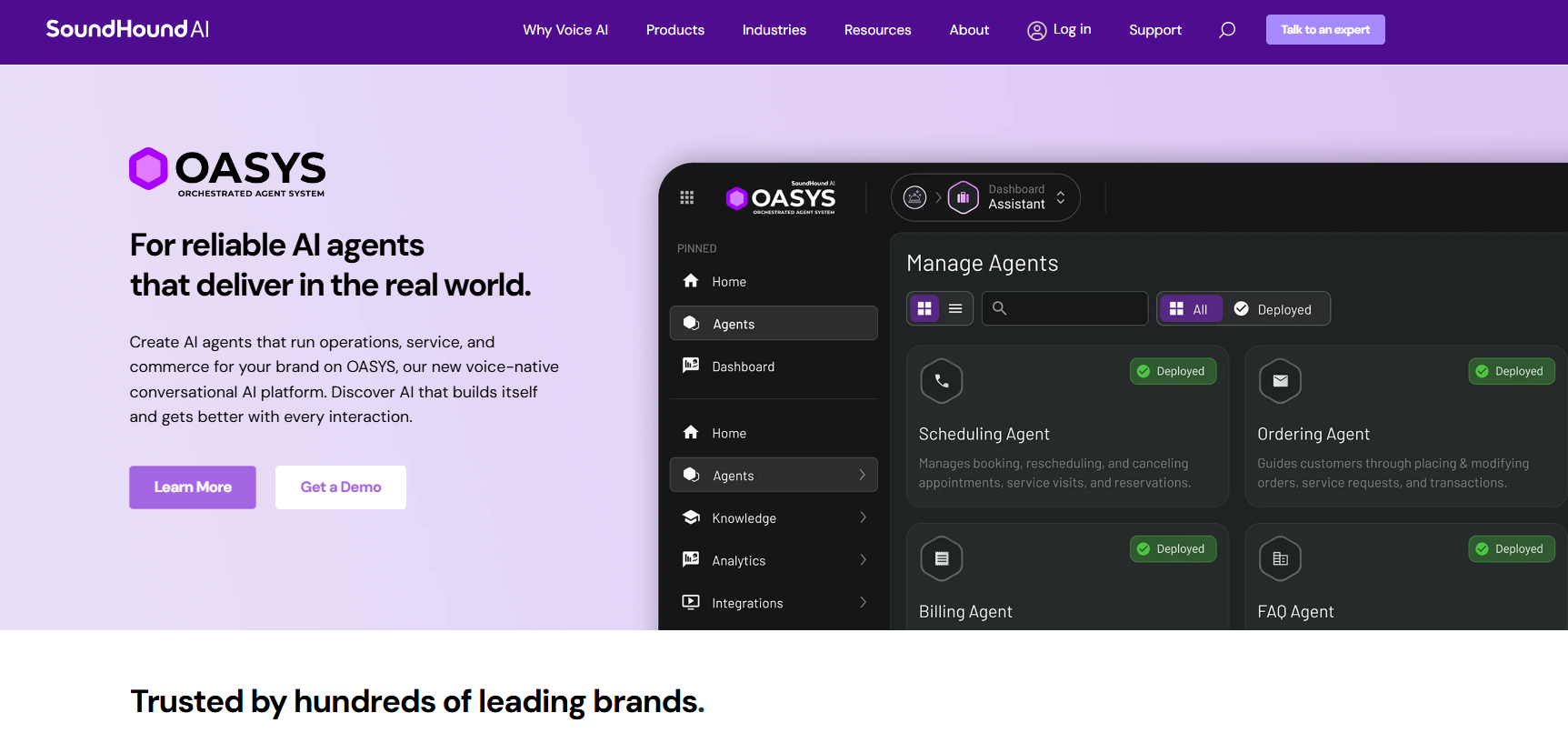
SoundHound AI is a publicly traded company with enterprise restaurant deployments, including large chains like Red Lobster, Torchy's Tacos, and Applebee's.
It's built for scale on its OASYS platform. It runs phone ordering, drive-thru lanes, and in-store kiosks across hundreds of locations at once, without slowing down during peak hours.
Main Features
- Dynamic Drive-Thru: multimodal ordering built for high-throughput drive-thru lanes
- Smart Lane and Dynamic Kiosk: pre-order and in-store kiosk voice ordering
- Smart Ordering: voice-enables phone, SMS, and app ordering from one menu
- In-Car Food Ordering: connects with in-car voice assistants for on-the-go orders
- Employee Assist and Voice Insights: back-of-house tools for onboarding and reporting
- Supports 25 languages currently, with a goal of expanding past 100
Pricing
Enterprise and custom-quoted.
This is built for chains and franchise groups, and the deployment model reflects that. It may not be a realistic fit for a single-location independent restaurant.
See our full SoundHound review here.
4. PolyAI

PolyAI is an enterprise conversational AI platform used by large hospitality brands, including hotels, casinos, and national chains. It also reports being trusted by 3,000-plus restaurants.
It handles complex, multilingual support and custom integrations that most independent restaurants don't have on hand. It's built with NVIDIA-backed infrastructure.
Main Features
- Handles reservations end to end: makes, amends, and cancels bookings 24/7 with no staff needed on the phone
- Answers common guest inquiries about parking, corkage, and hours automatically
- Captures large party and event leads even during busy service
- Accent recognition and multilingual conversation handling
- Enterprise security and compliance: SOC 2, HIPAA, GDPR, and PCI DSS as standard
- Learns and improves continuously from call data across all of its deployments
Pricing
PolyAI bills ongoing use per minute, and that rate covers performance tuning, maintenance, and 24/7 support rather than charging separately for those add-ons.
There's no flat rate card, so the actual cost depends on your call volume and contract terms. For context, enterprise deployments have been reported to run into six figures annually at scale.
Between the usage-based pricing and a multi-week enterprise sales process, PolyAI is built for large hospitality groups, not a single independent restaurant.
See our full PolyAI review here.
5. Hostie
Hostie is a virtual concierge for restaurants and hospitality, aimed at cutting down front-of-house phone interruptions during a rush. It handles calls, texts, and emails from one dashboard, with multilingual support and integrations across reservation, POS, and event-management platforms.
Built by a team of restaurant owners and operators who truly understand the challenges of the industry, Hostie believes that no call, text, or question should go unanswered, whether that's a routine hours question or a private-event inquiry that could turn into real revenue.
Main Features
- Answers calls, texts, and emails from a single, unified dashboard
- Multilingual support (up to 20 languages)
- Integrates with OpenTable, Resy, Tock, SevenRooms, Yelp, Tripleseat, Olo, Toast, and Square
- Real-time call transcripts and live visibility, with the ability to jump into a call
- Captures takeout orders by phone or text so staff can stay with in-house guests
- Guest insights and reporting, with data ownership kept on the restaurant's side
Pricing
- Essential — starting at $199/month: for walk-in restaurants that need reliable answering and quick guest follow-ups, with text-any-link ordering, standard customization, live transcripts, and the operator app.
- Premium — starting at $399/month, most popular: for full-service restaurants that want reservations and takeout communication in one place, adding full reservation integrations, premium customization, 24/7 support, and takeout ordering.
- Hospitality Plus — starting at $599/month: for full-service restaurants managing guest outreach and reservations at scale, adding cross-location booking, enterprise-level insights, white-glove service, and event management integrations — including the Perfect Venue connection.
See our full Hostie review here.
6. Kea AI

Kea AI is restaurant-native voice AI with a public order accuracy track record: the company reports handling more than 900,000 calls at 99.3% order accuracy. It integrates with 11-plus POS systems and also has a dedicated drive-thru product built for franchises.
Kea leans into the idea that the AI should know your menu as well as your best line cook. It flags 86'd items in real time and won't offer a substitution that isn't actually on the menu. It’s an order-taking AI agent for full-service and quick-service kitchens that live and die by ticket accuracy.
Main Features
- Connects directly to the POS to take orders, including modifiers, and sends them to the kitchen display system
- AI Menu Analyzer keeps the assistant limited to your actual menu, so it won't invent items
- Answers unlimited simultaneous calls and throttles orders during a backup
- Dynamic FAQs, managed through a portal with mobile login for on-the-go updates
- Real-time call reporting to flag missed revenue and caller trends
- Delivery and payment support, including pay-on-arrival and Apple/Google Pay
- Direct integrations with 11-plus POS systems, including Toast, Square, Clover, and Olo
- Dedicated high-speed ordering product for drive-thru and franchise locations
Pricing
Kea runs a single flat plan at $450 a month, with no per-order costs and unlimited calls included.
Restaurant groups with 20 or more locations get custom volume pricing instead of the standard flat rate.
See our full Kea AI review here.
7. Loman AI

Loman AI is a voice AI phone system built for independent restaurant owners and growing multi-unit brands that want full order-taking and reservation handling without an enterprise price tag. It takes phone orders and reservations and syncs both directly to your POS and payment systems, with same-day go-live coming up consistently as a selling point.
Loman markets itself heavily on order accuracy and integration depth, positioning itself as a step up from simpler call-answering tools that only handle FAQs or routing.
Main Features
- Takes phone orders for pickup and delivery and sends them straight to the POS
- Securely takes credit card payments over the phone
- Answers questions about hours, menu, and policies
- Syncs with Toast, Square, SpotOn, Clover, Aloha, and Olo, among others
- Books, modifies, and cancels reservations 24/7
- Live dashboard showing calls, transcripts, orders, and outcomes in one place
- Update menu items, hours, and business info in seconds, with changes going live on the next call
- Handles unlimited simultaneous calls and quotes wait times during a rush
Pricing
Loman doesn't publish pricing on its site, but it does offer a Starter plan (basic call management) and a Premium (for ordering and reservations) one. Third-party estimates have put plans somewhere in the $199 to $299 a month range with a setup fee around $149, but treat that as a rough ballpark.
See our full Loman AI review here.
8. Sadie
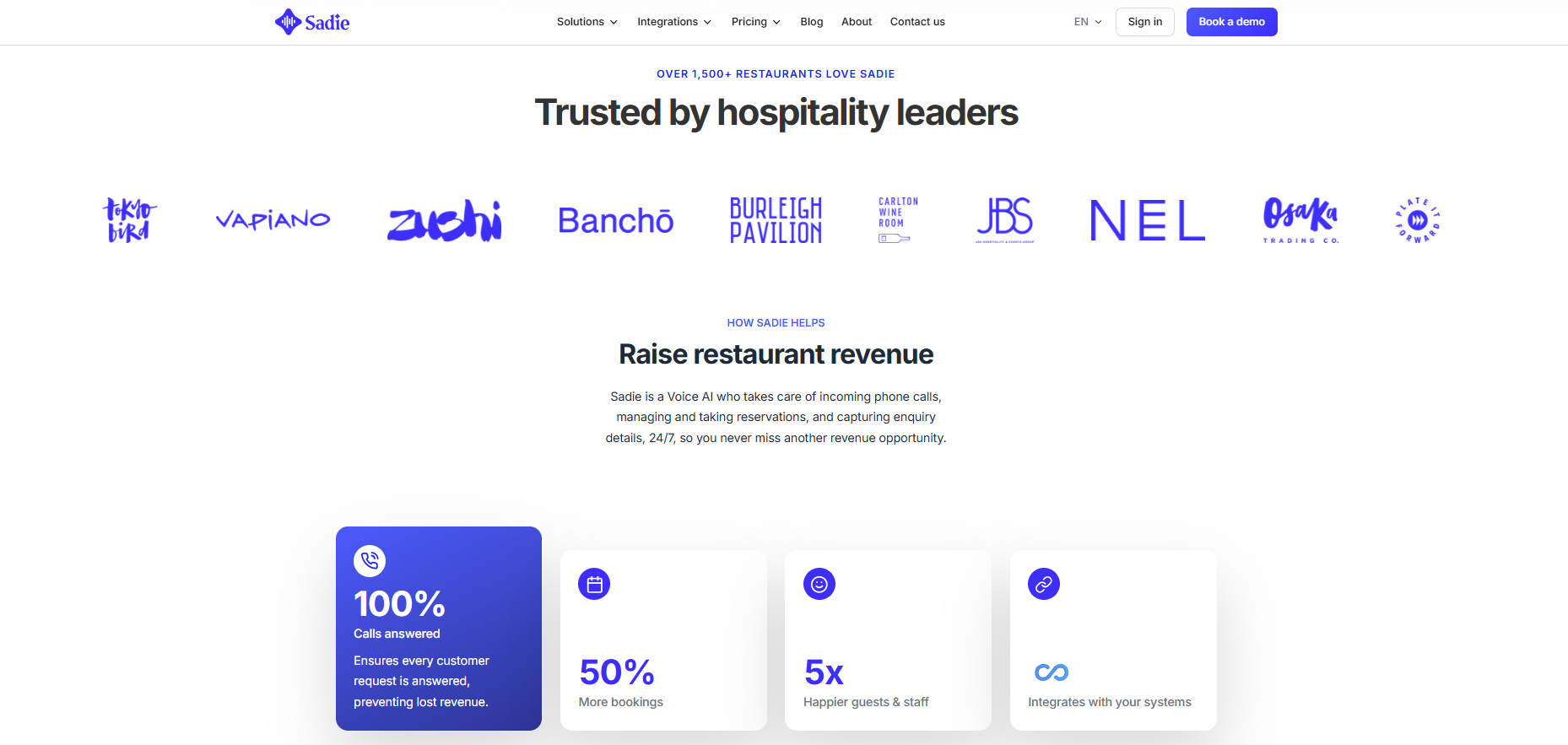
Sadie is an AI host built specifically for hospitality, focused on reservations, orders, and private-event lead capture. It's owned by Valsoft, a global enterprise software group, which gives it more institutional backing than some of the newer standalone startups on this list.
It has a live Tripleseat integration and a Payfacto POS integration, plus a reported 20-concurrent-call capacity. Sadie leans on tone as a differentiator, too, marketing itself around "warmth and emotional intelligence" rather than positioning as a bare-bones answering machine.
It offers three parallel plans built around what you actually need the phone to do: just answer calls, take reservations, or take orders.
Main Features
- Unlimited minutes and simultaneous calls, with 24/7 call handling
- Automatic Google Hours sync, so callers always get accurate hours
- Smart guest memory that recognizes repeat callers
- Reservation management, including booking, canceling, modifying, and confirming by phone
- Take-away order handling with POS integration
- Live Tripleseat integration for private-event and catering leads
- Payfacto POS integration for order and payment sync
- Call analytics, including transcripts and summaries
- Goes live in under 24 hours with no training required, and keeps your existing phone number
Pricing
- Answers — $149/month: for businesses that need every call answered, with unlimited minutes, 24/7 call handling, unlimited simultaneous calls, and automatic Google Hours sync.
- Reserves — $349/month: for venues that take reservations by phone, adding smart guest memory and full reservation management on top of everything in Answers.
- Orders — $349/month: for high-volume ordering and POS workflows, adding smart guest memory and take-away order handling with POS integration on top of everything in Answers.
See our full Sadie review here.
Comparison Table: AI Voice Agent Answering Services for Restaurants
Here's how the eight systems stack up at a glance:
How to Choose the Right One for Your Restaurant
Ask yourself these four questions, in this order:
- Do you need full order-taking, or just call answering and reservations?
- What's your call volume? Low volume favors flat or per-caller pricing. High volume makes per-minute billing risky, since it can get expensive fast.
- What POS or reservation system are you already running? Ask specifically whether the sync is native or a webhook workaround, since that changes how much manual work it actually saves your team.
- Do you want AI-only, or a solution with a live-agent safety net for VIP or complex calls?
- What's your budget? Flat monthly plans on this list range from under $150 a month to enterprise contracts running into six figures a year, so it's worth ruling out anything outside your range.
Answer these honestly and the shortlist narrows down.
It also helps to know what's already working against you. A solid restaurant waitlist system and a clear view of your day-to-day restaurant operations both make it easier to tell whether a missed call is really a phone problem or something further upstream.
The demand for this kind of automation isn't slowing down, either. Market researchers project the AI voice agent market will keep growing at a rapid clip through the early 2030s, so the tools on this list will likely look different within a year or two and it’s worth starting to leverage them now.
And using one means no more missed opportunities for revenue as an AI phone answering solution works round the clock and handles multiple calls simultaneously – which is just something your host can’t do.

The Bottom Line
The right tool here depends on your call volume, how complex your menu is, and whether you need full ordering or just reliable call coverage. A quiet neighborhood spot doesn't need PolyAI's enterprise horsepower. A busy multi-location group taking hundreds of phone orders a week probably needs more than Slang's FAQ-and-reservation focus.
Once one of these tools answers the phone and captures the lead, though, someone still has to turn that inquiry into a booked event. That's where Perfect Venue comes in.
An AI voice agent tool can catch the call and grab the details. Perfect Venue turns that lead into a sent proposal, a signed contract, and a booked event without you chasing down emails in between. See how Perfect Venue turns inquiries into booked events and book a demo today!
FAQs
What's the difference between a voice AI answering service and a basic AI receptionist?
A basic receptionist usually answers FAQs and takes messages. A full voice AI answering service can check real availability, book a reservation, take a complete food order, and sync all of it to your POS system without a staff member touching the phone.
Can voice AI actually take a complete food order with modifications?
Some can, some can't. Tools like Maple, Kea AI, Loman AI, Hostie, and Sadie AI are built to handle multi-modifier orders and route them straight to the kitchen with the right integrations in some cases. Others, like Slang, focus on taking reservations and answering FAQs.
Do these tools work with my existing POS system?
Yes, restaurant-specific AI solutions are made to function well with your existing restaurant stack. Most of the tools on this list integrate with Toast, Square, Clover, or similar systems.
How much does a voice AI phone system cost for a restaurant?
Pricing spans a wide range, from roughly $150 a month on the low end to enterprise contracts running into six figures a year for platforms like PolyAI. Get a direct quote before you budget for one, since published prices shift often.
Will callers know they're talking to AI?
Often not right away. Modern systems respond in under a second and sound close to a live person. Most tools also let the AI agent hand off to a staff member if the caller asks for one or the request gets too complicated to handle on its own.


