
The phone rings for the third time in ten minutes. Your host is seating a table, your server is pouring wine, and nobody's free to pick up. That missed call might have been a $60 takeout order or a party of six looking to book a table for Saturday.
It's a familiar problem, and it's a big one.
Between 5 p.m. and 8 p.m., the average restaurant misses 32% of all incoming calls, right when the dinner rush makes staff least available to answer.
That's the gap voice AI phone platforms like Maple aim to close.
In this review, we'll walk through what Maple actually does, what each pricing tier includes, and what to check before you sign a contract.
What Is Maple?
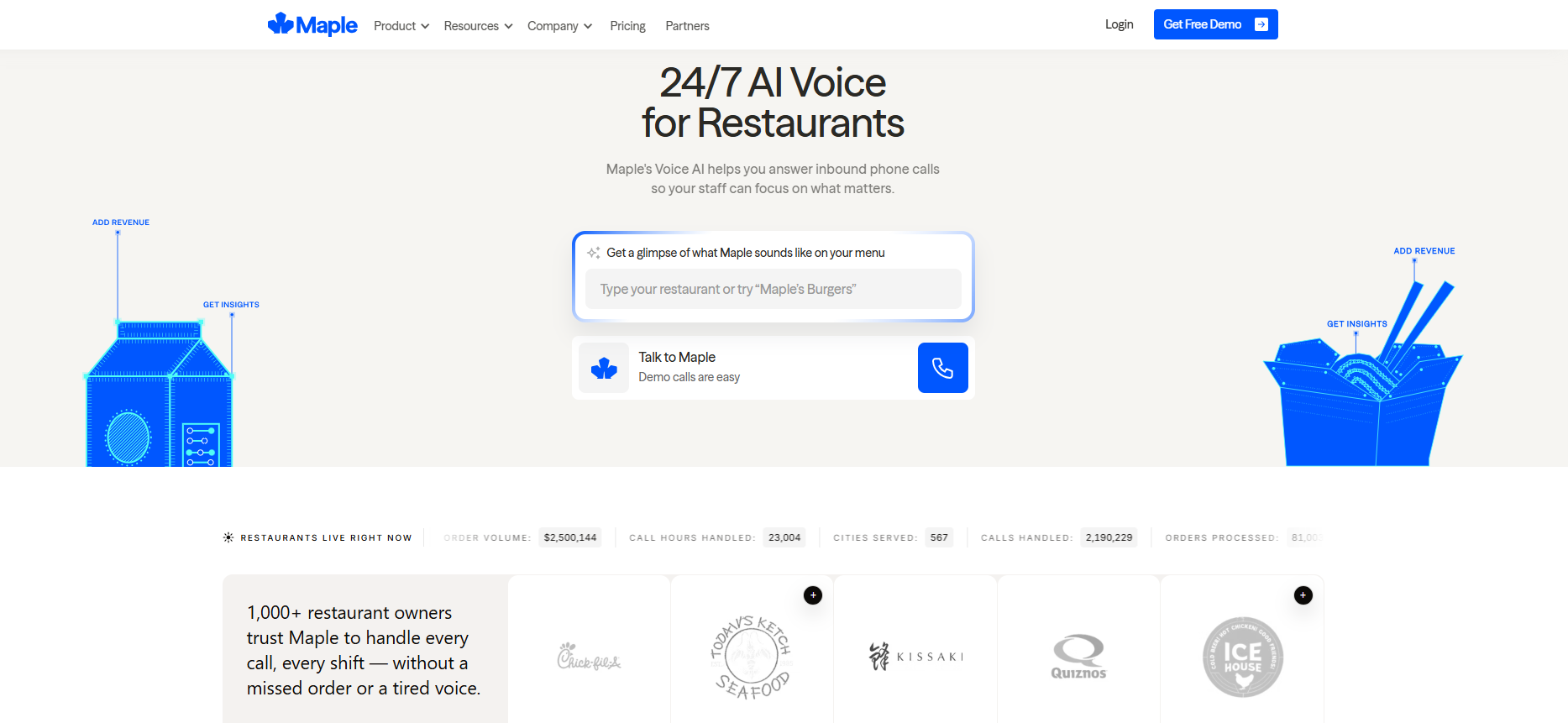
Maple is a voice AI phone answering platform built specifically for restaurants. It picks up incoming calls around the clock, so a guest calling at 11 p.m. gets the same quick response as one calling during Tuesday lunch.
The company launched in December 2023 under the name Argo Labs before rebranding to Maple. It's also a graduate of Amazon's AWS Generative AI Accelerator, a competitive program that backs early-stage AI startups with funding and technical mentorship.
Since launch, Maple has answered over 1 million calls for restaurants with a 92% resolution rate, meaning the AI handled the call without a staff member needing to step in.
How Does Maple Work?
Maple answers your restaurant's phone line with a humanlike voice AI. Callers can ask about hours, request the address, or ask if you've got a gluten-free option on the menu, and the system answers instantly.
From there, depending on your plan, Maple can take a full takeout order, complete with modifiers and allergy notes, and send it straight into your POS.
Maple also books, changes, or cancels reservations, syncing directly with your existing reservation platform so tables never get double-booked.
Calls that fall outside the AI's scope, like a VIP request or a complicated catering inquiry, get transferred to your staff automatically. You still get full call transcripts, so nothing gets lost between the AI and your team.
Key Features
Maple's feature set breaks down into a few areas: order taking, reservations, revenue tools, and reporting. Here's what each one covers.
Order Taking and POS Integration
Maple handles complex orders, including modifications, combos, and allergy requests, and pushes them directly into your kitchen workflow. It integrates with major POS systems, including Toast, Square, Clover, Skytab, Oracle, and Quantic.
The company has also announced newer partnerships with Shift4's SkyTab and Quantic that pull menu data straight from your POS, which can cut down on manual menu setup.

Reservations
Maple's reservation tools let callers book, modify, or cancel a table through natural conversation. The system connects directly with OpenTable, pulling real-time table availability so confirmations are accurate.
Dynamic Menu Sync
Maple auto-updates sold-out items and daily specials in real time, so the AI never sells a caller something the kitchen ran out of an hour ago. That accuracy matters more as more guests place phone orders instead of using a restaurant online ordering platform.
Upselling and Payment Processing
On its higher tier, Maple includes intelligent upselling, where the AI suggests add-ons or combos during the order, plus secure payment processing over the phone.
Multilingual Support
Maple currently supports English, Spanish, and Mandarin Chinese, with French available in beta by request. More than 1 in 5 people in the United States speak a language other than English at home. A phone system that can only handle English calls is going to miss some of those guests entirely.
Analytics and Reporting
Maple's dashboard tracks call volume, order accuracy, upsell conversion, and response times. This kind of reporting is useful for spotting your busiest call windows, which can help you plan staffing around the hours when the phone rings most.
Maple Pricing

Maple splits its pricing into three tiers:
Maple Voice: $150/Month (or $85/Month Billed Yearly)
This is voice and FAQ only. It covers 24/7 phone answering, hours and FAQ responses, automated call transfer, advanced call analytics, and multilingual voice.
It does not include ordering or reservations.
Maple Pro: $350/Month (or $220/Month Billed Yearly)
Maple's most popular tier includes everything in Voice, plus the features most restaurants actually want: taking phone orders into your POS, booking and modifying reservations, OpenTable integration, intelligent upselling, secure phone payments, and order confirmation texts.
If phone order volume plays a meaningful role in your restaurant's profit margin, it's worth running the math on Pro versus Voice before you commit, since ordering and reservations only come with the Pro tier.
Maple Enterprise: Custom Pricing
Built for multi-unit groups, Enterprise includes everything in Pro plus multi-location management, custom integrations, custom voice training, a dedicated success manager, priority support, and a master service agreement.
Who Maple Is For
Maple works well for restaurants that want a tiered entry point into phone automation. If you just need reliable, humanlike call answering and don't take many phone orders, the Voice plan gets you there without paying for features you won't use.
For restaurants where phone orders and reservations are a real revenue driver, the Pro plan is where the platform earns its keep. It's a reasonable fit whether you're a single independent restaurant or managing a few locations that don't yet need the custom controls of Enterprise.
Multi-location groups with more complex needs, like per-store menu overrides or dedicated support, will land in the Enterprise tier. No technical expertise is required to get set up on any plan; Maple's team handles phone integration, menu programming, and staff training as part of onboarding.
Restaurants that are also stretched thin on the floor might find that fewer missed calls take some pressure off an already tight restaurant staffing situation, since staff aren't pulled away from guests to answer routine questions.
Fewer missed calls and fewer interrupted service moments also tend to add up to a better overall restaurant customer experience, not just a fuller order queue.

Things to Know Before You Sign Up
A few things are worth confirming before you commit to a plan.
First, double check which tier you actually need. The entry-level Voice plan only covers call answering and FAQs. If you want Maple to take orders or handle reservations, you need Pro. It's an easy detail to miss when you're comparing the $85 sticker price against competitors.
Second, ask about your specific POS. Maple lists broad compatibility, but menu complexity varies a lot between restaurants, and a live demo with your actual menu will tell you more than a features list.
Third, if you're a multi-location group, ask directly about per-location customization and reporting. Enterprise pricing is custom, so get specifics on what's included before comparing it to a flat-rate competitor.
Final Thoughts
Maple gives restaurants a straightforward way to stop losing calls during the rush, with a tier that scales from basic answering up to full order taking and reservations.
The key is matching the plan to what you actually need. If phone orders and reservations matter to your business, Pro is where the platform delivers the most value.
Of course, the phone is only one piece of running a smooth events and reservations operation.
If you're managing private events, group bookings, or want to get in front of new guests without lifting a finger, Perfect Venue's event management software can help you manage inquiries, send proposals, and get booked faster, all from one place.
FAQ
How much does Maple cost?
Billed monthly, Maple's Voice plan starts at $150 a month for call answering and FAQs only. The Pro plan, which adds ordering and reservations, runs $350 a month. Paying yearly brings those down to roughly $85 and $220 a month, respectively. Enterprise pricing is custom for multi-location groups.
Does Maple take phone orders?
Yes, but only on the Pro and Enterprise plans. The base Voice plan handles call answering and FAQs without taking orders.
What POS systems does Maple integrate with?
Maple integrates with Toast, Square, Clover, Skytab, Oracle, and Quantic, among others.
Does Maple handle reservations?
Yes, on the Pro and Enterprise plans. Maple integrates with OpenTable to book, modify, and cancel reservations in real time.
Does Maple process payments over the phone?
Secure phone payment processing is included on the Pro and Enterprise plans, along with intelligent upselling during the order.


