OpenTable is one of the biggest names in restaurant reservations. Most diners already have the app on their phone.
But a lot has changed since it first launched, including pricing and the feature set. We took a fresh look at OpenTable in 2026. Here's whether it still holds up for restaurants weighing their options.
Below is our breakdown of what OpenTable offers, what it costs, and where it falls short.
About OpenTable
OpenTable launched in 1998 and is now part of Booking Holdings, the parent company behind Booking.com and Priceline.
The platform lets restaurants list their availability online. Diners can browse, compare, and book a table in a few taps.
OpenTable has built up a large diner network over the years. According to OpenTable's own data, more than 1.9 billion guests get seated at restaurants through the platform every year. Diners also run close to 859 million searches on OpenTable looking for somewhere to eat. And the company reports more than 155 million verified reviews (diners can only leave a review once they've actually dined at a restaurant).
That scale is OpenTable's biggest selling point. If getting discovered by new diners matters to your restaurant, it's hard to find a bigger network to plug into.
The platform now serves tens of thousands of restaurants, bars, and wineries across more than 100 countries. That means the network effect holds up in most major dining markets, not just a handful of big cities.
OpenTable Ratings and Reviews
OpenTable consistently holds strong ratings on the major B2B software review platforms. It sits in the 4.4 to 4.7 range out of 5 stars on sites like G2 and Capterra. Those scores are based on well over 1,300 verified reviews.
Reviewers tend to praise the ease of use and the size of the diner network. But the cost comes up again and again as the main sticking point.
That’s a fair summary of what to expect. OpenTable is a reliable, well-built platform, but it comes at a real price, especially once your covers start climbing.
OpenTable Features
OpenTable's main focus is on reservations, but the platform has expanded well past a simple booking calendar. Restaurant managers get a full set of tools for running front-of-house operations day to day.
Reservation and Table Management
OpenTable’s GuestCenter gives hosts one place to manage reservations, walk-ins, and table availability throughout a shift. Staff can view upcoming bookings, make changes, and see which tables are open without switching between different screens.
Restaurants can also create a digital floor plan that reflects their actual dining room layout. OpenTable’s table assignment tools then help hosts match each party with a suitable table based on group size, timing, and availability. This gives the front-of-house team a clearer view of the dining room and helps reduce delays between parties.
Core and Pro plans also include online and in-house waitlists. Guests can join the list remotely or check in when they arrive, rather than gathering around the host stand. During busy weekend shifts, these tools can make seating decisions faster and help the dining room maintain a steadier flow.
Guest Relationship Tools
OpenTable builds a guest database with tags and notes for every diner. Staff can flag food allergies, seating preferences, and VIP status in seconds.
Pro plan subscribers get access to 360 guest profiles with deeper insights. They also get automated email campaigns and custom post-dining surveys to bring regulars back.

Marketing and Reviews
Restaurants can run digital advertising campaigns through OpenTable to reach diners at the exact moment they're searching for a table.
The platform also includes review management tools and a customizable booking widget for your own website.
Voice AI for Phone Bookings
One of the newer additions is a voice AI assistant that answers calls in the restaurant's own voice. It captures reservations and handles routine guest questions around the clock. It's a sign of where the reservations category is headed.
More platforms are building AI phone answering into their core product or adding integrations for a voice AI tool built for restaurants.
Private Dining and Events
OpenTable also offers a private dining lead form so restaurants can capture event inquiries alongside regular reservations. It's a useful way to catch leads you might otherwise miss.
That said, it's built for capturing interest, not managing the full event lifecycle. Restaurants that host a lot of private parties typically still need a dedicated tool like Perfect Venue that can handle proposals, deposits, and documents like a banquet event order.
Reporting and Analytics
Managers can track dining history, table turn times, and server cover counts through OpenTable’s reporting tools. These insights help teams spot busy periods, compare shift performance, and schedule staff based on actual demand rather than guesswork.
Restaurants can also create and manage gift cards within the platform, which gives guests another way to pay for a future visit and encounter them to come back.
Available OpenTable Integrations
OpenTable connects with a wide range of restaurant tech. That means it slots into an existing tech stack instead of replacing it. The partner list spans booking channels, POS systems, payments, marketing, and more.
Here's a closer look at what's available in each category.

Booking Partners
These partners help diners find and book your restaurant beyond OpenTable's own app and website.
- Search and maps: Google, Apple Maps, Microsoft Bing, and Yahoo
- Travel and discovery: TripAdvisor, KAYAK, Priceline, Trip.com, Booking.com Business, MICHELIN Guide, Eater, Infatuation, and TimeOut
- Social platforms: Facebook and Instagram, Snapchat, TikTok, Howbout, Franki, and Aspire Concierge
- Voice and AI search: Amazon Alexa, Cerence, OpenAI's ChatGPT, and Perplexity
- Membership and rewards: AAA, Rewards Network, and Uber
POS Systems
Connecting your POS to OpenTable links table and reservation data with spend data. Staff get a fuller picture of every guest as a result.
OpenTable integrates with: Toast, Square/Block, Squirrel, Lightspeed (K-Series and L-Series), SpotOn, SkyTab, Upserve, Lavu, GoTab, Aloha, Micros (RES 3700 and Simphony), POSitouch, Dinerware, Epos Now, PixelPoint, Silverware, Tabit, Agilysys/Infogenesis, Auphan, CBS Northstar, Givex, Genius for Restaurants, Shiji/Infrasys, Tonic, and Union POS.
Still deciding on the backbone of your tech stack? It's worth reading up on what to look for in a restaurant management POS system first. Your POS choice affects which reservation platforms will sync cleanly.
Payments
These integrations handle secure, PCI-compliant payment processing for deposits and prepaid experiences: Stripe, CardPointe from Fiserv, FreedomPay, and Spreedly.
Email Marketing and Loyalty
These tools turn OpenTable guest data into targeted campaigns and rewards programs.
- Email marketing: Mailchimp, Emma, Fishbowl, Bloom Intelligence, and Loyalist
- Loyalty and rewards: Paytronix, PeopleVine, Blackbird, and Bilt Rewards
Phone Automation
Voice AI for restaurants is one of the fastest-growing integration categories. Current OpenTable partners include Slang.ai, Maple, PolyAI, Hostie, Loman AI, and Sadie.
Newer entrants include Bonnie, Maitly, Axify, AskArthur, Millie AI by One Touch, Tablevoice, TimeShark, Timmy AI, VoicePlug, and Yelp Host.
Menus, Reviews, and Property Management
A handful of smaller categories round out the list. Menu tools like Deliverect, Popmenu, Single Platform, and Storekit keep your OpenTable listing current.
Review platforms like Chatmeter, Marqii, Review Trackers, and Widewail help centralize reputation management.
Hotels and larger properties can also connect a property management system like Cendyn or Oracle Opera.
Other Integrations
OpenTable rounds out its library with a few more specialized tools. These include DoorDash for off-premise order data, Google Ads and Analytics for marketing attribution, and Distil for enterprise data insights.
OpenTable Pricing
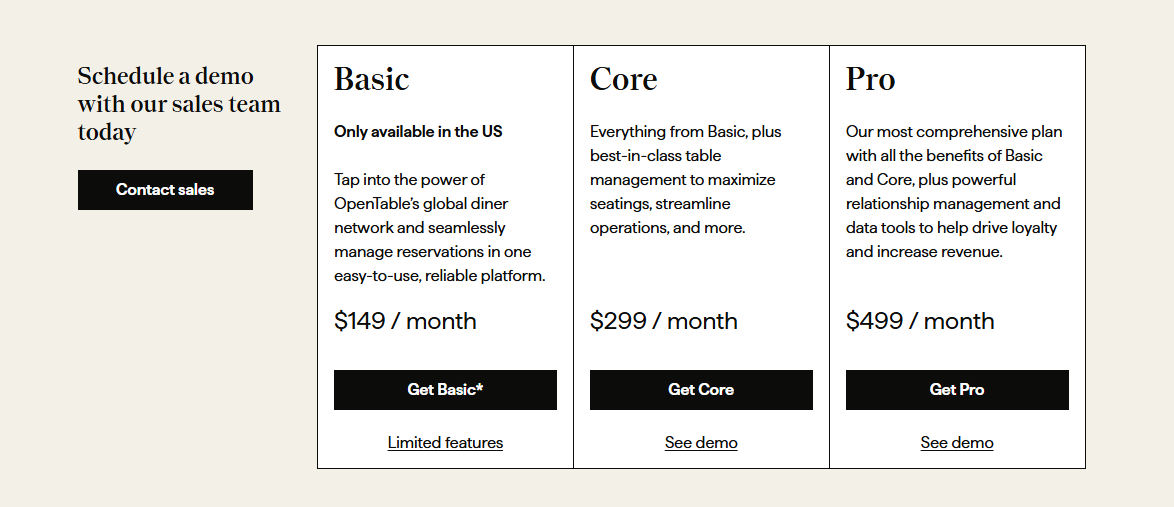
OpenTable offers three subscription plans. Here's what each costs as of 2026.
A network cover fee only applies when a diner discovers your restaurant through OpenTable's website, app, or affiliate network. Phone bookings and walk-ins never incur a fee.
Restaurants also aren't charged for no-shows or cancellations, since you only pay for diners who actually get seated.
A few extra costs are worth budgeting for too.
OpenTable charges a 2% service fee on prepaid experiences across all three plans. It also charges a 2% fee on prepaid ticketing for Core and Pro subscribers.
The standard contract runs for one year and renews automatically. Mark your calendar if you want to cancel or switch plans.
On the plus side, OpenTable's tiered structure gives smaller restaurants an entry point at $149 a month. On the downside, the fees add up fast for high-volume restaurants. The jump from Basic to Pro is a big one if you need the full guest relationship toolkit.
Pros
- Access to a massive diner network, with 1.9 billion guests seated annually across OpenTable's platform
- Comprehensive reservation management, with 93% positive sentiment across nearly 900 Capterra reviews for flexible booking, modifications, and reminders
- A user-friendly interface that's easy to navigate
- Intuitive reservation management that helps cut down on overbooking risk
- Responsive, fast customer support
- Voice AI phone assistant that handles calls and captures reservations after hours
Cons
- Subscription costs plus per-cover fees climb quickly for high-traffic restaurants, and Core to Pro adds $200 a month
- Reviewers want more customization, especially around guest profiles and operational hours, according to G2 reviews
- Some Capterra reviewers report infrequent updates, occasional glitches, and slow loading, with 42% negative sentiment on update-related reviews
- Private dining tools are limited to a lead capture form, not a full event management workflow
- Standard contracts run for a full year and auto-renew, so switching platforms requires advance notice

Is OpenTable Worth It for Your Restaurant?
OpenTable makes the most sense for restaurants that rely on new diner discovery to fill seats. That's especially true in competitive markets where visibility matters. If most bookings come through your own website, phone, or repeat guests, you're mainly paying for the operational tools rather than the network, so it's worth weighing the subscription cost against tools you may already have.
Technology investment is only getting more important industry-wide. The National Restaurant Association's 2026 State of the Restaurant Industry report found that operators are prioritizing technology that improves efficiency. That's true even as many restaurants navigate tighter margins this year, and that pressure is exactly why the math matters here.
A busy restaurant doing hundreds of covers a month can rack up a real bill on top of its fee. So it pays to run the numbers before signing a year-long contract.
Here's a good rule of thumb. Track what share of your covers come through OpenTable versus your own website, phone, or walk-ins each month. If the network share is small, you may be paying for reach you're not using. If it's large, the fees are likely buying you real, incremental business.
It's also worth comparing OpenTable against its direct rivals before committing to a year-long contract. Our breakdowns of Tock vs. OpenTable and Resy vs. OpenTable cover how the platforms stack up on pricing and features.
Conclusion
OpenTable remains one of the strongest options for restaurants that want reservation software backed by a massive diner network. It handles table management, guest relationships, and marketing well. And the newer voice AI assistant adds a useful layer for after-hours calls.
Where OpenTable falls short is private events. Its lead capture form is a nice bonus, but it isn't built to manage proposals, deposits, or full event workflows. A dedicated event management platform handles that job better.
Perfect Venue fills that gap, and it connects with OpenTable through a Zapier integration. That means private event leads flow straight into your Perfect Venue pipeline without manual entry.
Already using OpenTable for reservations? Start a free trial of Perfect Venue for an easier way to manage private dining too.