SevenRooms has grown into one of the more established names in restaurant guest experience software. DoorDash completed its acquisition of the platform in June 2025, and that shift has brought new resources, a sharper AI focus, and a few structural changes to how the software is packaged.
Restaurant technology keeps moving fast, and reservation software is no exception. According to the National Restaurant Association's 2026 State of the Restaurant Industry report, technology now shapes on-premises ordering and payment, marketing, customer feedback, and back-office work across the industry, and most operators plan to keep investing there in 2026.
SevenRooms sits right in the middle of that shift, so it's worth understanding exactly what you're buying before you sign a contract.
This guide covers what SevenRooms does today, including its newer AI table management and Voice AI tools, who the platform works best for, how its pricing tiers break down, and where it still falls short.
If you're a venue manager comparing guest experience software for 2026, here's everything you need to know.
What Is SevenRooms?
SevenRooms is a guest experience and reservation platform built for restaurants, hotels, nightclubs, bars, and membership clubs. Founded in 2011 and based in New York City, the company built its reputation on a CRM that helps operators understand guests instead of just booking their tables.
It’s a cloud-based data platform that connects reservations, guest profiles, and marketing tools in one system.
The platform is designed to help venues manage reservations, build guest profiles, and turn one-time visitors into regulars using data collected at every touchpoint, from the first booking to the tenth visit. Restaurants can use that data to personalize service, target promotions, and track how each guest interacts with the brand over time.
SevenRooms now operates as part of DoorDash's Commerce Platform, following DoorDash's $1.2 billion acquisition of the company, which closed in June 2025. That ownership change hasn't altered the core product much yet, but it has already added deeper reservation marketplace reach through DoorDash and Deliveroo.
Who Is SevenRooms For?
SevenRooms markets itself across seven venue types: independent restaurants, restaurant groups, hotels, membership clubs, nightclubs and bars, sports and entertainment venues, and breweries or wineries.
According to SevenRooms, more than 15,000 restaurants around the world currently use the platform.
The software scales differently depending on your setup. A single independent restaurant might only need the Starter tier to offer restaurant reservations and basic CRM, while a multi-location hospitality group can lean on the Group Portal add-on to manage bookings, users, and reporting across every venue from one dashboard.
We've found it works best for operators who already have some data strategy in mind, rather than teams just looking for a simple booking widget.
Key SevenRooms Features
SevenRooms organizes its features around three goals: filling more seats, running smoother service, and turning customer data into repeat visits.
Below, we break down each feature area and what's actually included.
AI-Powered Table Management
SevenRooms now markets its table management tools as AI-powered, and this is one of the more notable additions to the platform.
The system handles seating, pacing controls, cover forecasting, and waitlist automation in real time, helping front-of-house teams seat guests faster and smooth out busy shifts. This lets a host stand focus on greeting guests instead of manually juggling a seating chart during a Friday night rush.
Reservations, Waitlist, and Marketplace Reach
Guests can make restaurant reservations through your website, Google, Instagram, or Yelp, and SevenRooms now also connects to the DoorDash and Deliveroo reservation marketplaces. SevenRooms says this gives venues access to over 50 million potential diners without paying cover fees on those bookings, which is a direct benefit of the DoorDash acquisition.
SevenRooms also offers Voice AI as an add-on, which answers guest calls and books reservations automatically so restaurants don't miss call-in bookings during a rush.
This fits a broader industry trend: PYMNTS Intelligence reports that conversational AI chatbots have become one of the most widely adopted restaurant AI use cases, with a large share of brands already using them daily to handle orders and reservations.
For restaurants that lose bookings every time the phone rings during service, this add-on can pay for itself fairly quickly.
If you're weighing SevenRooms' Voice AI against other options, check out our roundup of the best voice AI answering services for restaurants.

Guest CRM and Marketing Automation
Every booking, visit, and order feeds into a unified guest profile. Restaurants can use this restaurant CRM data to track diner preferences and spend, and trigger automated email, text, and campaign journeys to bring guests back.
Custom and auto-generated tags let staff segment guests by preference, visit frequency, or spend level, so marketing feels personalized.
Deloitte's research on consumer loyalty found that over half of Gen Z and millennial consumers say they'd spend more at a brand that offers a personalized experience, compared to far fewer older consumers.
According to SevenRooms, the goal here is to turn guest data into higher checks and more repeat visits without extra manual work from staff, and the tagging system is what makes that kind of personalization possible at scale.
Email, Text, and Search Marketing
Beyond core CRM tools, SevenRooms sells add-on marketing channels, including email marketing, WhatsApp and text marketing, and search and social discovery tools.
The email marketing add-on is built for restaurant-specific sends like seasonal menus, newsletters, and promotions.
Text marketing works similarly but through SMS, which tends to get opened faster than email.
The search and social discovery tools plug your booking widget into popular search and social channels, so guests can go from browsing to booked without leaving the app they're already using.
Events, Experiences, and Private Line
SevenRooms supports ticketed events and bookable experiences directly through your website, which can generate revenue before guests even walk in the door. Think chef's tasting menus, wine dinners, or holiday events sold as upgrades during the booking flow, rather than one-off promotions staff have to manage manually.
Event Management is available as an add-on, and it covers menus, minimums, availability, and payments in one flow, similar to how a private dining booking works.
Venues that want a deeper look at dedicated event management software built specifically for private events may want to compare options here, since SevenRooms treats events as an add-on to its core reservations product rather than its main focus. Perfect Venue, for example, is built around private event bookings from the ground up, so it's worth comparing the two if events make up a meaningful share of your revenue.

SevenRooms also offers Private Line, which gives top guests a direct text line to your team for reservations and special requests. Staff can see the full conversation history, so a regular guest doesn't have to re-explain their usual table preference every time they text in.
Reputation Management
SevenRooms compiles reviews and guest feedback so teams can reply in one place and keep a pulse on brand sentiment. This ties back into the same guest profiles used for CRM and marketing, so a complaint or compliment can inform how staff treat that guest next time they book.
Operations and Reporting
Beyond guest-facing tools, SevenRooms includes a set of operations features aimed at the back end of the business.
Revenue management gives operators recommendations for pricing and availability based on demand patterns, while online ordering supports commission-free delivery, pickup, and on-premise orders through a customizable widget.
Reporting and group reporting round this out, letting multi-location groups track covers, cancellations, no-shows, and revenue across every venue in one dashboard instead of pulling separate reports for each location. For hospitality groups running five or more venues, this consolidated view is often the deciding factor between SevenRooms and a simpler, single-venue tool.

SevenRooms Integrations
SevenRooms offers more than 100 integrations, spanning reservation discovery, point of sale, and payments. That breadth is one of its stronger selling points if your venue already runs on a specific tech stack.
On the discovery side, it connects with Google, Instagram, Meta, Tripadvisor, and the DoorDash and Deliveroo reservation marketplaces, plus regional platforms in markets like the UK and the Middle East.
For point of sale, SevenRooms partners with Toast, Square, NCR Aloha, Squirrel Systems, Lightspeed, Silverware, and Oracle, among others.
Payment and ordering partners like Deliverect and FreedomPay round out the back end, letting orders and payments sync automatically instead of requiring manual entry.
If you're still weighing which restaurant management POS system fits your setup, it's worth confirming compatibility before you commit to a guest experience platform, since switching POS providers later can be a bigger headache than switching reservation software.
Getting Started With SevenRooms
Because SevenRooms is fully customized, there's no self-serve signup flow. You'll need to request a demo, walk through your venue's needs with a sales rep, and agree on a tier and add-ons before onboarding begins.
Onboarding typically involves connecting your POS and payment systems, importing existing guest data, and configuring tags, automations, and marketing templates around your brand.
For a single independent restaurant, this can take a few weeks. For a multi-location group syncing several POS systems and legacy guest databases, it can take considerably longer.
SevenRooms Pricing (2026)
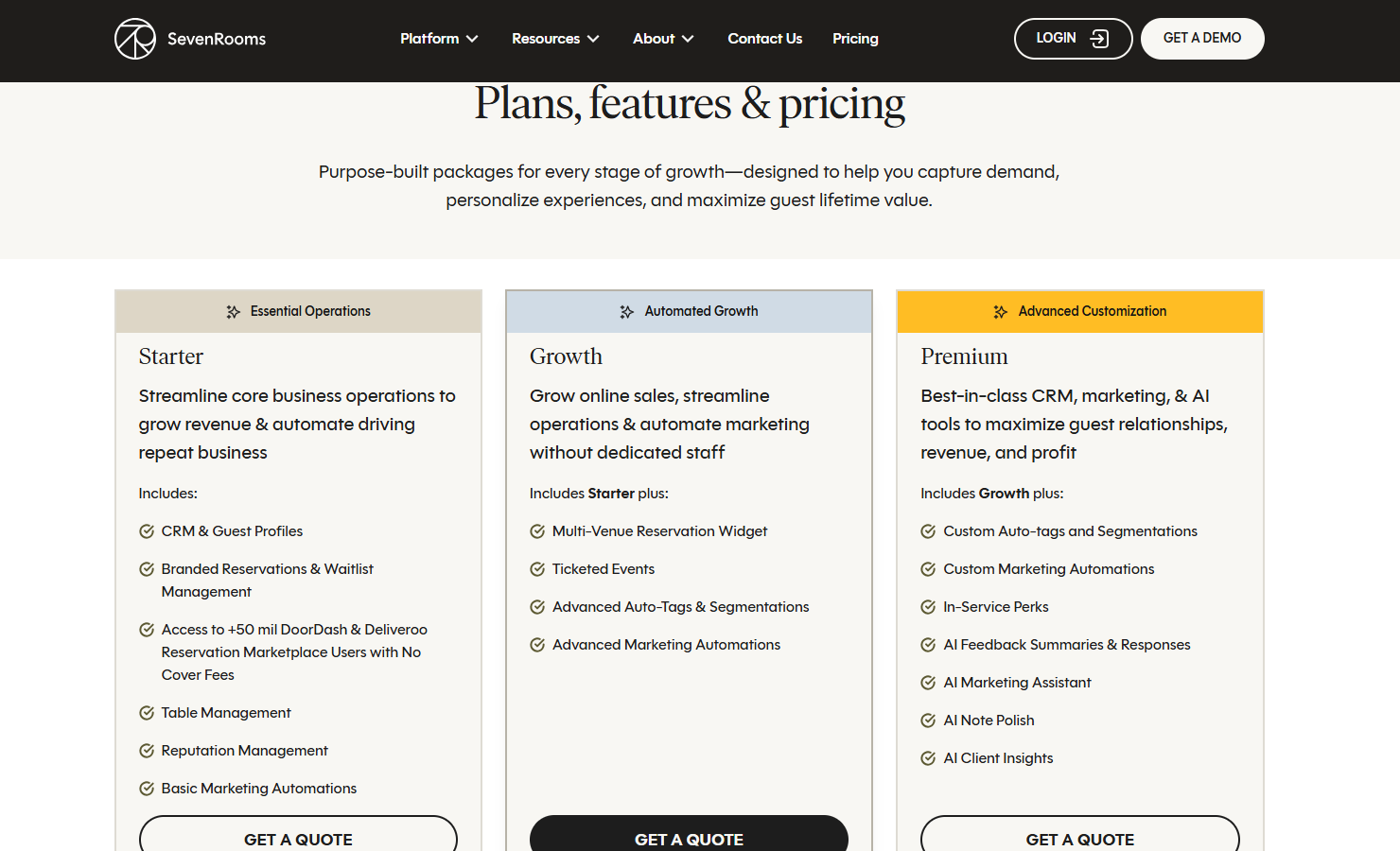
SevenRooms doesn't publish flat monthly rates. Instead, it sells three tiers, each built on the one before it, and you'll need to request a quote for actual costs.
- Starter: Covers CRM and guest profiles, branded reservations and waitlist management, marketplace access through DoorDash and Deliveroo with no cover fees, table management, reputation management, and basic marketing automation. This tier suits independent restaurants that mainly need reservations and a foundational CRM.
- Growth: Adds a multi-venue reservation widget, ticketed events, advanced guest tagging and segmentation, and more advanced marketing automation. This tier makes sense once a single venue outgrows basic automation, or a small group needs to manage bookings across two or three locations.
- Premium: Adds custom tagging and automations, in-service perks, and a set of AI tools including feedback summaries, a marketing assistant, note polishing, and client insights. This is the tier aimed at operators who want SevenRooms handling as much of the guest relationship as possible, from the first booking through post-visit follow-up.
On top of these tiers, SevenRooms sells add-ons separately, including Email Marketing, Event Management, Voice AI, WhatsApp and text marketing, API and integrations access, and a Group Portal for multi-location reporting.
Because pricing is fully custom, costs will vary a lot based on venue size, add-ons, and how many locations you're running.
Pros of SevenRooms
- Deep guest data capture: Profiles build themselves automatically from every booking, visit, and order, so staff aren't manually entering guest preferences.
- Marketplace access without cover fees: The DoorDash and Deliveroo reservation marketplaces open your venue to millions of diners without the per-cover charges some discovery platforms carry.
- AI-powered table management: Real-time seating and pacing tools help hosts turn tables faster during peak service.
- Voice AI add-on: This catches call-in reservations that would otherwise go to voicemail or a busy host stand.
- Restaurant-specific marketing automation: Email, text, and campaign tools are built around hospitality use cases like seasonal menus and event promotions, not generic e-commerce templates.
- Multi-venue reporting: Groups running several locations can track covers, cancellations, and revenue from one dashboard instead of pulling separate reports per venue.
Cons of SevenRooms
- No published pricing: You'll need to go through a sales call and demo before you get a real quote, which makes early budget comparisons harder.
- No free trial: There's no way to test the platform hands-on before committing to a contract.
- Event Management is a paid add-on: It's not built into every tier, so venues that run frequent private events will need to budget for it separately.
- Longer onboarding: Custom setup, POS syncing, and data migration mean onboarding can take longer than simpler, self-serve tools, especially for multi-location groups.

Is SevenRooms Right for Your Restaurant?
SevenRooms works well for restaurants and hospitality groups that want deep guest data, marketing automation, and marketplace reach all in one platform, especially now that it's backed by DoorDash's scale.
It's a stronger fit for teams with the time and budget to work through a custom setup than for those wanting to launch same-day.
If you manage private events alongside day-to-day reservations, Perfect Venue's event management software is designed specifically for that side of the business, with digital proposals, automated workflows, and a simple setup you can start using right away.
Enjoy a free trial of Perfect Venue and see how it fits into your venue's workflow.
Frequently Asked Questions
Does SevenRooms offer a free trial?
No. SevenRooms doesn't offer a free trial or a free version. You'll need to book a demo and go through a custom quote before you can use the platform.
Who owns SevenRooms?
SevenRooms is owned by DoorDash, which completed its $1.2 billion acquisition of the company in June 2025. SevenRooms operates as part of DoorDash's Commerce Platform.
Does SevenRooms work for single-location restaurants?
Yes. The Starter tier is built for independent restaurants that mainly need reservations, waitlist management, and a basic CRM, though larger add-ons like Voice AI and Event Management are available if you need them later.
How is SevenRooms different from OpenTable?
SevenRooms puts more emphasis on guest CRM, tagging, and marketing automation, while OpenTable leans more on its diner-facing discovery network. We've compared the two in more detail in our SevenRooms vs. OpenTable breakdown.